Pub Settles and Benches: Sizes in mm, Covers per Length and How to Specify Them
What a pub settle is and how big it should be: seat and back heights in mm, depth, length per cover, settles facing across a table, backless benches, timber and fixing.
Planning seating for a venue? Send your floor plan or sizes and we'll quote from shop drawings, factory-direct.
Request a quotation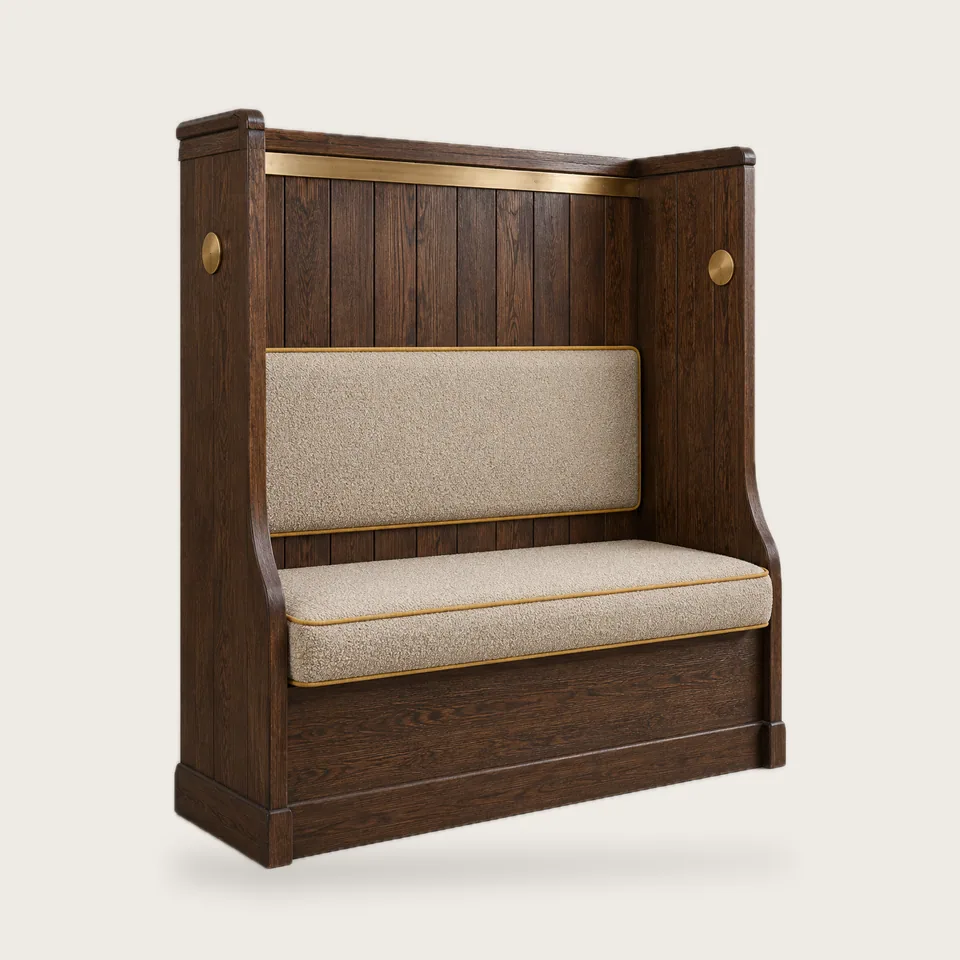
Short answer: A pub settle is a timber bench with a high back and solid ends. Build it with a 450–460 mm seat height for a 730–760 mm table, 420–480 mm of usable seat depth, 550–600 mm overall depth and a back of 1,050 mm for a low settle or 1,350–1,500 mm for a high-back snug settle, allowing 600 mm of length per cover. A backless bench at the same table needs only 330–420 mm of depth, but is comfortable for shorter stays.
Settles and benches are the oldest fixed seating in the British pub and still some of the hardest-working. This guide gives the working dimensions, shows how many covers each length seats, and lists what to put on the drawing so a new settle looks as if it belongs in the room.
What is a settle, and how is it different from a bench or a booth?
A settle is a long wooden seat with a back and arms or side boards, traditionally tall enough to keep draughts off the people sitting on it. A bench is a seat for several people that may or may not have a back; a backless bench at a table is sometimes still called a form in older inventories. A booth is an upholstered seat, usually one of a facing pair, built around a table.
| Type | Back height | Upholstery | Typical depth | Where it works |
|---|---|---|---|---|
| High-back settle | 1,350–1,500 mm | Seat pad and back pad only | 550–600 mm | Snugs, firesides, period interiors |
| Low settle | 900–1,100 mm | Seat pad, optional back pad | 550–600 mm | Bar areas, dining rooms that need sightlines |
| Box settle | 900–1,450 mm | Lift-up seat with storage below | 550–650 mm | Where storage is short |
| Backed bench | 750–900 mm | Seat and back pads | 500–600 mm | Long tables, garden rooms |
| Backless bench | Seat only, 450–460 mm high | None, pad or loose cushion | 330–420 mm | Under windows, long sharing tables |
The Settles & Benches collection follows these families, from the 1,450 mm Fairweather Oak Settle to low plank and cushion benches.
What are the standard dimensions of a pub settle?
| Dimension | Typical value | Notes |
|---|---|---|
| Seat height (with pad compressed) | 450–460 mm | For a 730–760 mm table; keep 280–300 mm between seat and table top |
| Usable seat depth | 420–480 mm | Timber seats can be slightly shallower than upholstered booths |
| Overall depth | 550–600 mm | Including back boards and any back pad |
| Back rake | Slight, roughly 5–15° from vertical | Settles sit more upright than upholstered booths |
| Back height, low | 900–1,100 mm | Seated guests can see over a 900 mm back |
| Back height, high | 1,350–1,500 mm | Screens the seated guest's head; creates a snug |
| Arm or side board height | About 200–250 mm above the seat | For leaning and pushing up to stand |
| Length per cover | 600 mm | 550 mm minimum; more for long stays |
A timber settle with only a thin seat pad feels firmer than an upholstered booth, so many operators add a loose back cushion or a fixed back pad at shoulder height. The Ironmonger Spindle Settle is a compact 1,050 mm example with a flat seat pad.
How many covers does a settle or bench seat?
Divide the seat length by 600 mm for comfortable covers, or by 550 mm for the tight maximum.
| Length | Comfortable covers (600 mm) | Maximum (550 mm) |
|---|---|---|
| 1,200 mm | 2 | 2 |
| 1,500 mm | 2 | 2 |
| 1,800 mm | 3 | 3 |
| 2,400 mm | 4 | 4 |
| 3,000 mm | 5 | 5 |
| 3,600 mm | 6 | 6 |
Settles with solid side boards lose a little usable length to the boards themselves; measure the seat between the boards, not the overall length.
How do settles work facing each other across a table?
Two settles facing across a table make the traditional pub booth or snug. The distance from back to back is:
Back-to-back length = settle depth + table width + settle depth − overlaps
With 550 mm deep settles, a 700 mm table and the table overlapping each seat front by 50 mm, that is 550 + 700 + 550 − 100 = 1,700 mm. Use 1,750–1,800 mm if the settles have thick back pads or a noticeable rake. The settle length is usually 1,200 mm for two covers a side and 1,800 mm for three.
Because a settle cannot slide back, the table position decides comfort. Push the table up to the seat front with only a small overlap; set too far away, guests lean forward on hard timber all evening. Our guide to pub tables for booths and banquettes covers table sizes, tops and bases.
How should a backless bench sit at a table?
Backless benches are space-savers along windows and at long sharing tables.
- Height: 450–460 mm, the same as a chair, with 280–300 mm between bench seat and table top.
- Depth: 330–420 mm. Narrower benches tuck under the table edge; wider ones are steadier for broad guests.
- Length: match the clear length between the table's legs or ends, so the bench can slide in when the room is cleaned.
- Legs and stretchers: splayed legs and low stretchers are stable but catch heels; keep stretchers low or set back.
- Stay length: a backless bench is comfortable for a drink or a quick lunch, not for a long Sunday meal. Put the longest stays on settles or upholstered seating.
A deeper window bench, such as our 600 mm deep Bay Window Bench, with loose bolster cushions against the wall, gives backless-bench economy with more comfort.
Which timber and finish should a settle have?
Oak is the traditional choice and still the most requested, for its strength and the way it darkens with use. Ash and beech are strong alternatives, and any of them can be stained to match existing panelling or a bar front. Finish choice is a trade-off:
| Finish | Spills and cleaning | Repair | Look |
|---|---|---|---|
| Commercial lacquer | Good | Spot repair by a finisher | Even, low sheen |
| Hard wax oil | Fair | Easy to refresh on site | Natural, matt |
| Traditional wax | Poor with spilt drinks | Easy, frequent | Deep patina |
For a busy pub floor, lacquer on the seat and arms with a matched sample kept on site for touch-ups is the practical choice. Send a photograph and an offcut of existing joinery if the settle has to sit beside original panelling.
What fire rules apply to settles and benches?
Bare timber seats are not covered by upholstery fire tests, but any seat pad, back pad or loose cushion is upholstered seating. In UK pubs and restaurants that normally means specifying the pads to BS 7176 at the hazard level your fire risk assessment requires, which for most pubs is medium hazard (BS 5852 ignition sources up to Crib 5). Our guide to BS 7176 and Crib 5 explains who is responsible. Keep settles and their cushions a safe distance from open fires and stoves, as set by your fire risk assessment and the appliance installer.
How are settles fixed?
- High-back settles should be fixed. A 1,450 mm back has a high centre of gravity, and guests pull on it to stand up. Fix to the wall with concealed cleats or brackets, or to the floor.
- In listed buildings, fix to new work or to the floor rather than through historic panelling, and check with your conservation officer before fixing anything to original fabric.
- Low settles and benches can stand free if the layout changes for events, with felt or nylon glides.
- Removable pads with ties, straps or hook-and-loop strips make cleaning and replacement easy; our Pewter Lane Cushion Bench uses a pad held by two straps.
Checklist before you order
- Wall length measured at seat and back height, between any fixed obstacles.
- Settle or bench type, back height and overall depth.
- Seat height with pad compressed, and table height.
- Covers required and length per cover.
- Table size and position for settles facing each other.
- Timber, stain and finish, matched to a sample.
- Pads and cushions specified to the required fire standard.
- Fixing method, and listed-building constraints.
- Delivery route: door widths, stairs and turns for long settles.
Common mistakes
- Copying a domestic settle. Antique and domestic settles often have deep, low seats that do not suit a 760 mm pub table.
- Measuring overall length for covers instead of the seat between side boards.
- A high back with no fixing.
- Too much table gap. Hard timber seats punish a guest who has to lean forward.
- Unprotected waxed timber on a bar floor. Spilt beer marks it within days.
- Forgetting the pads in the fire specification. The cushion is upholstery even if the settle is timber.
FAQ
What is a settle in a pub?
A settle is a long wooden bench with a high back and solid ends or arms, built against a wall or around a fire. It is the traditional British pub seat and the ancestor of the upholstered booth.
How high is a settle seat?
450–460 mm with any pad compressed, for a standard 730–760 mm pub dining table. Keep 280–300 mm between seat and table top.
How tall is a high-back settle?
Usually 1,350–1,500 mm overall. Low settles that keep sightlines open are 900–1,100 mm.
How much bench length does each person need?
600 mm per cover for comfort, 550 mm as the minimum. A 1,800 mm settle seats three; a 2,400 mm bench seats four.
Can Booth & Bench make a settle to fit an alcove?
Yes. Booth & Bench (a line by EASEN Commercial Furniture) builds settles and benches to measured alcove and wall sizes in our own production base in Foshan, China, with a drawing for approval before anything is made.
Send us your measurements, a floor plan or a few photographs of the room, and tell us how many covers you need. We will come back with a layout suggestion and a quotation per metre.
Request a quotation